

Micro Prose 101: Say More with Less
Unpacking the art of micro prose — from first draft to publication


Hey writer-friend. New to The Forever Workshop? Read this. Back again? Here’s what we’ve got for you today…
A workshop for:
Writers who want to condense their craft into tiny, powerful pieces of writing.
Key takeaways:
Learn what micro prose is and draft your first piece
Big mistakes to avoid in micro works
How to create impact and meaning in a short piece of writing
Titling technique (seriously who better to learn from)
Your instructor:
Darien Gee — award-winning micro memoirist, author of five novels, teacher of creative non-fiction at UCLA and founder of Writer-ish with Darien Gee, helping writers master the art of micro prose

Micro Prose 101
Welcome, writers!
I’m Darien Gee, and today we’re diving into one of my favorite short forms: the micro.
In this lesson, you’ll learn how to craft tiny stories that pack enormous emotional punch. We’ll explore what makes micro prose different from other short forms, discover why constraints can be your creative superpower, and practice techniques that transform fleeting moments into unforgettable prose.
The most powerful stories often emerge from small moments and careful attention. Let’s find out how...
What Is Micro?
I define micro as 300 words or fewer, not including the title — a simple constraint that changes everything about how you approach your story.
Think of micro as a snapshot, not a movie. You’re capturing one perfect frame that suggests an entire story rather than telling it. Here are a few more elements of micro:
Brief but complete: There’s a beginning, middle, and end.
Focused on one moment or idea: There’s no room for tangents or multiple stories.
Precise in language: Every word must earn its place.
Emotionally resonant: It lingers with the reader long after they’ve finished reading.
This layout generally fits on one page with generous white space — I refer to it as a basket holding your narrative. It feels clean, direct, and distilled. The visual simplicity reinforces the clarity of the prose and subtly influences the words.
Let’s see how this works with Brenda Miller’s piece, Swerve (289 words), originally published in Brevity:
Swerve
I’m sorry about that time I ran over a piece of wood in the road. A pound of marijuana in the trunk and a faulty brake light—any minute the cops might have pulled us over, so you were edgy already, and then I ran over that piece of stray lumber without even slowing down. Thunk, thunk, and then the wood spun behind us on the road. Your dark face dimmed even darker, and you didn’t yell at first, only turned to look out the window, and I made the second mistake: What’s wrong? That’s when you exploded. You’re so careless, you don’t even think, what if there had been a nail in that damn thing, you yelled, your face so twisted now, and ugly. And I’m always the one that has to fix it whenever something breaks.
I’m sorry, I said, and I said it again, and we continued on our way through the desert, in the dark of night, with the contraband you had put in our trunk, with the brake light you hadn’t fixed blinking on and off, me driving because you were too drunk, or too tired, or too depressed, and we traveled for miles into our future, where eventually I would apologize for the eggs being overcooked, and for the price of light bulbs, and for the way the sun blared through our trailer windows and made everything too bright, and I would apologize when I had the music on and when I had it off, I’d say sorry for being in the bathroom, and sorry for crying, and sorry for laughing, I would apologize, finally, for simply being alive, and even now I’m sorry I didn’t swerve, I didn’t get out of the way.
How/why does it work?
Let’s look at those elements again:
1. Brief but complete:
For some stories, the beginning/middle/end may be emotional as well as physical. In Swerve, the beginning is the moment the speaker drives over the wood. That’s when everything begins. Next (the middle) is context (present moment contraband in trunk, the strained exchange, the past of realizing every moment of apology). The end is less about the physical arrival to a place but the hard-earned emotional arrival to regret.
2. Focused on one moment or idea:
The one focus/idea here is about apology and regret, radiating from that single piece of wood in the road.
3. Precise in language:
At 289 words, Miller effectively tells this story via repetition and dialogue. Other ways she uses language to do some work for her: the foreboding thunk thunk of the wood (the reader hears and feels that moment); “Your dark face dimmed even darker” (setting the emotional tone while also raising the stakes; the reader is now nervous and alert); the escalating lists of apologies until the end.
4. Emotionally resonant:
Last lines in micro are where the reader leaves the story, and Miller leaves us with: “I’m sorry I didn’t swerve, I didn’t get out of the way.” The reader now understands this means more than avoiding the wood on the road. It’s also where she finds her title, which we also now understand on multiple levels.
Writing with Constraint
Writing short is not just about word count, but about what’s possible within a specific limit. After years of experimenting and teaching micro, I’ve found the 300-word form to be the perfect short-form storytelling container. It allows enough space for detail without requiring excessive backstory or explanation.
In a moment, we’ll look at some more examples and prompts to get you writing, but first, here’s how I teach micro prose using three constraints:
1. The Constraint of Focus / Intention
Before writing, clarify your focus: what moment or feeling do you want to explore? Enter your writing session with deliberation and clarity. Set your intention and then let it go.
2. The Constraint of Time
Set a ten minute timer for your first draft — no more, no less. Trust me on this. The time constraint bypasses your inner critic and connects you to memory and emotion. You know you only have so much time to say what needs to be said. The more you practice this, the better you’ll get at hitting the ground running when the timer goes off.
A couple of notes: if you finish early, keep writing. Sometimes the story turns in the final moments, those last few seconds. When the timer goes off, you must stop. Finish your sentence or thought, and don’t worry if the piece doesn’t feel complete or doesn’t make sense (that’s what revision is for).
3. The Constraint of Word Count
First draft: don’t worry about word count for this generative effort. If you’re using the 10-minute constraint, you’ll end up in the range of 75-500 words. The 300-word constraint comes in during revision. Your final draft should be 300 words or fewer, not including the title.
The constraint of micro helps writers of all genres distill a moment to its most essential emotional truth. I recommend starting with whatever is easy and true (and by true I am referring to emotional truth), and then start experimenting. The key is to know what the burning moment of a piece is and then set about practicing how to set that moment on fire.
To help you do just that, here are some more examples and prompts using some of the techniques we’ve looked at so far:
Capturing the Burning Moment
The Visitation by Beth Ann Fennelly (130 words)
I remember being in the car on the way to my sister’s surprise funeral. In the backseat, I think. I can’t imagine who was driving. At a stop sign my head swiveled to a flicker in the roadside greenery: a fox, poking its snout from between two bushes. I thought, or chose to think, That is my sister. That is my sister, come back in animal form to tell me it’s okay. She’s okay. I’ll be okay.
But it was not okay. She was not okay. I would not be okay. I would not be okay for so long that when okay arrived it couldn’t place me. It looked right past the veil of shivering leaves, my long red snout, my gloved paws swiping tears into my little black mouth.
— Published in Heating and Cooling: 52 Micro-Memoirs (WW Norton & Co, 2017)
Fennelly doesn’t waste any time getting to the point. We know what has happened in the first line: my sister’s surprise funeral. But the clear burning moment of the piece is not that fact. It’s the vision of a fox that transforms itself into both the speaker and the sister, the embodiment of love, loss and grief.
✍️ Now you try it:
Write about a sign you received from someone (or something) you’ve lost.
The Brief but Complete Story:
Inheritance by Edward Hirsch (22 words):
When Kurt became my father, his parents became my grandparents. I adopted them as my own. Their history became my history too.
— Published in My Childhood in Pieces: A Stand-Up Comedy, a Skokie Elegy (Knopf, 2025)
Some might say this just backstory. But when we’re talking economy of prose, it’s not just how you say it (or in how many words), but what you say. What is conveyed in these handful of words? You could, in fact, call this a micro love story.
✍️ Now you try it:
Write about something you inherited that wasn’t an object.
Using Concise and Precise Language
Apple Cake by Abigail Thomas (175 words)
I am not a girl. I am the grandmother of six. I bake cakes for all my grandchildren. My name is synonymous with “cake.” I have taught them this. Nana, Cake, and they clap their little hands. Apple cake, this is my specialty. In the past twelve days I have baked seven apple cakes for seven separate occasions. These cakes contain walnuts and raisins as well as golden oil and apples. You would beg me for a slice if you could see these cakes. You would beg for their perfume alone. They do well for holidays. Thanksgiving, for example. Anniversaries. I have had my good times and my bad. This was long ago, my dears, before most of you were born. I was not a prudish girl. Nor was I wise. When I was young I gave myself away; it was all I had to offer. But not today. Today I will bake a cake. The cake is not a metaphor. Say the words “apple cake.” Apple cake. See how the mouth fills with desire.
— Published in Safekeeping: Some True Stories From a Life (Anchor Books, 2001)
The speaker lays it all out — no flowery language or sugarcoating the details, no elaborate backstory — she offers only what we need to know. And yet, Apple Cake covers a lot of ground: When I was young I gave myself away; it was all I had to offer. As for language, she invites the reader to experience the very words (Say the words “apple cake.”). She engages our senses: You would beg for their perfume alone. The final line brings in so much longing and happiness: See how the mouth fills with desire.
✍️ Now you try it:
Write about something you are known for making and what it means or evokes.
Titles
Let’s talk titles for a second. Titles are important. Like, really important.
Naming our work helps it land and reinforces for us that our writing has value and possibility.
Titles help a piece take form, and they are one of the most important elements of micro writing. You must title every piece when you write it. I’m talking about the first draft. It’s part of the magic of micro and separates this in your mind from “just another piece of writing” that eventually gets lost. Titles have the capacity to do some heavy lifting in micro prose, helping you save valuable word count real estate for the piece itself.
If titles stress you out, just adapt the prompt (if the prompt was “write about a keychain,” call your piece “Keychain”), look inside the micro for a word or phrase, or go with an emotion that feels adjacent. Treat it as a “working title” for now — the piece may change during revision and demand a new name. But until then, call it something.

Redrafting & Developing Your Micro
I am a big believer in first drafts when it comes to micro, and what these drafts are trying to show us. It’s important to take a moment to first understand what has shown up on the page. See if you can articulate for yourself what the piece ended up being about and then decide how you want to revise the work.
Sometimes it makes sense to revise a piece immediately, and other times it makes sense to sit with it for a bit. Note interesting words or phrases, even ones you don’t understand, even typos or misspellings. Is there an emotional weight to the piece? What is revealed at the end — what becomes known? If you chose one or two emotions that capture the piece, where does it show up? Look for an anchor phrase or sentence that is a pivot point (aka your burning moment).
Here are some quick tips for revising your drafts, and some common pitfalls to avoid:
Micro Revision Strategies
Read-Aloud Test: Catch rhythm and clunkiness. Notice when your voice lifts or slows. Ask why.
Necessity Question: Ask, “What happens if I cut this?” Then cut it anyway and see if it works. The first and last sentences are always good candidates, too.
Synonym Search: Replace phrases with single words, eg: walked quickly → hurried.
5Ws and 1H Review: Welcome back to elementary school! Who? What? Where? When? Why? How? You don’t have to include all of this, but when re-reading your work, see how much detail you included for each. You can apply this same lens to published pieces you love and you’ll be surprised at how many of the 5W’s and 1H are included overall.
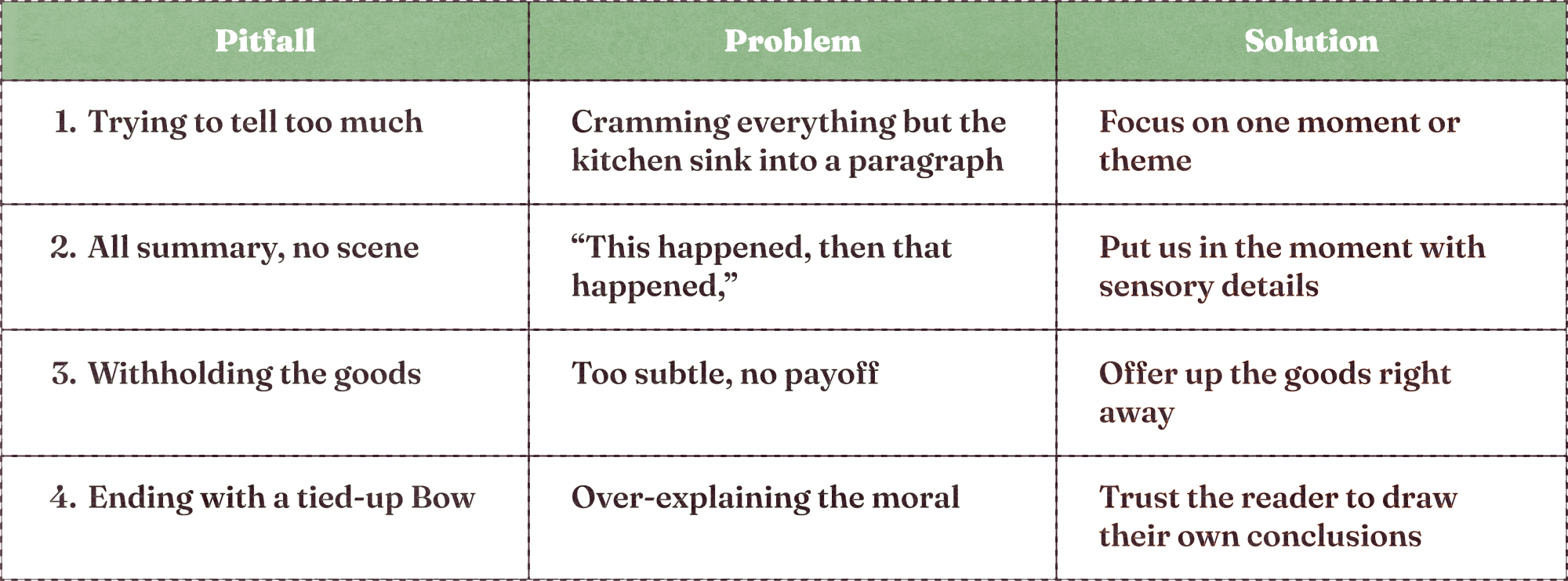
Common Micro Pitfalls (and How to Avoid Them)
Read Like a Micro Writer
You may have heard this elsewhere but I’ll say it again here — reading makes us better writers. This is absolutely true for micro, which allows us to do more than, say, dissecting an 85,000-word novel or memoir. That would not only take forever, but would only be one book. As writers, we benefit from reading widely and broadly, and you could read (and study) hundreds of micros in the time it would take you to read one book. This means your chances of getting good at writing micro (because you’re robustly reading micro) is exponentially increased over other literary forms.
Reading micro is not only fast, but you can do several reads of a single piece to really understand the architecture of the work. Always read first as a reader, without a highlighter or red pen — just read for the pure enjoyment of it. That’s three minutes, maybe five. Then go back and read as a writer. This means you want to understand how the author made choices about the piece. What’s happening in the first line? The last? What words or phrases grab you? How does the author impart information about the 5Ws/1H so the reader has some idea of time and place? What techniques do this use to pull you in and keep you reading until the end? Or did you stop? Where? Why?
When we read as writers, it matters less if we “like” a piece. What matters is “how” a writer accomplished what they did in the space available, and if any of those tools might be helpful to you and your writing.
Keep writing, drafting and refining. And once you have a small body of work, think about sending it out. You can submit to literary magazines that focus on flash and short prose, or go for a standard literary magazine that might like to include some micro amongst their fiction, non-fiction, poetry and art. I recommend having at least nine micros you can mix and match, and submit 3-5 per submission call. Follow the submission guidelines, but many editors are willing to treat micros of 300 words or less as they would poetry submissions.
(See the resources section below for more advice on submitting to lit mags — and a list of some of my favorite short prose authors on Substack.)
A Final Thought on Small Moments
Your voice doesn’t get smaller in micro — it gets clearer and more concentrated. Writing in miniature teaches us to notice what matters: a gesture, a word, a pause, a breath. The smallest stories often reveal the largest truths. Every micro you write is a distillation of attention and care. The more you practice the form, you’ll find that small can hold everything.

Share Your Micro:
✍️ Post your micro in the comments for feedback! ✍️
First drafts welcome — include a title and initial word count if written in 10 minutes.
More Micro Writing Resources:
A 12-part comprehensive guide to flash fiction:

Create atmosphere & tension using sensory details:

Or use the gift of the gag for some funny flash:

Learn how to edit your work with a professional eye:

Find everything you need to submit your micro to lit mags here:

And join Darien’s next micro prose workshop here:

Recommended short prose authors on Substack:
Add your favorites in the comments!
I resubscribed to this substack specifically for this workshop and it was well worth it!
Thanks Darien, this lesson was spectacular. I am writing a collection of micro-poems at present; the 'pivot point' resonated with me - off to edit. :)