



Welcome to The Forever Workshop’s MFA Newsletter. Today, we bring you an essay about getting an MFA at 50, written by our wonderful friend Andrea.
Everything published here is free to enjoy, courtesy of our partnered universities. (Not interested? Turn off MFA emails here.
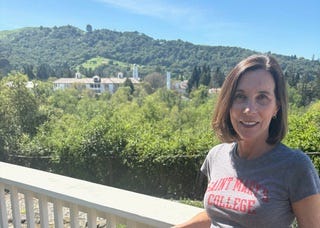
I have a photo from 2013, the three of us standing in bright sun on the back deck—my daughter, my son, and me—each of us wearing a t-shirt announcing the university that we’d head off to at summer ‘s ends. My daughter went to Boston, my son to Southern California, and I stayed put to attend the small, liberal arts college, Saint Mary’s College of California, in our hometown in San Francisco’s East Bay. My kids, twins and 18, were moving into the next phase of their education and their lives, a new independence. And me, at 50, I was pursuing an MFA in Creative Nonfiction Writing, moving on with an empty nest and a dream to fulfill.
I’d seriously considered applying to graduate school when we moved to our tiny town eight years earlier. Getting an MFA in writing was something I’d thought about for years, since my late twenties. But marriage, career, kids, money, and probably a lack of confidence, had diverted me from that path. Now the idea was palpably within reach. Saint Mary’s MFA program had a good reputation, and it was right there, a five-minute walk from the house. From our backyard, I could see the white stucco walls and red clay tile roofs of the Mission-styled buildings on campus. I could hear the bells chime in the chapel tower on the hour throughout the day. But when we arrived in northern California in 2005—a big move from Chicago where I’d lived for 20 years—with two ten-year-olds, two cats, two birds, a new puppy, and a husband with a busy job—I felt we all needed time to settle in. The family’s needs resonated louder than the church bells that were calling to me.
I’d been working as medical writer and editor, which paid decently well at the time, but it was solitary, slow-paced work. I felt the creative hole in my writing life deepening. So, I went to work writing for a local newspaper and then moved on to magazines. Although I was late to journalism, I figured it out. I’m curious by nature. Reporting and interviewing came easily. I liked meeting people and exploring my new surroundings through their stories. Along the way, I wandered down to Saint Mary’s College every chance I got to listen to readings by visiting writers, which were often open to the public.
Before I applied to SMC, I met with the Director of the CNF Program, the wonderful writer Marilyn Abildskov. She could sense my excitement, my desire. She knew I could write—I had loads of clips. I’d been edited and edited others—I understood that cycle. I knew not to be precious about my writing. But Marilyn also knew what I didn’t know: that an MFA in Creative Writing would push me into unfamiliar and sometimes scary territory and challenge me to write more authentically, work in new forms, and take risks. The truth is, back then, I didn’t really know what I’d be getting into.
Although I’d worked as a writer and journalist for many years, I’d never been in a writing workshop.
Although I had a basket filled with hand-written journals, I’d never shared a draft of a first-person piece, let alone had one published.
Although I had ideas, most of which defaulted to writing about other people and things, I didn’t yet know what I wanted to write in an MFA program.
As we wrapped up our meeting, Marilyn gave me a knowing smile and said, “Coming here, getting an MFA, will change your life.” I smiled back, and it felt like I floated out the door.
One of the first courses I took in the MFA Program was called Foundations, a requirement for all writers across genres. We met, 24 of us, twice a week, to analyze and discuss poetry, short stories, novels, and essays. The poets sat clustered together, erudite and articulate, they were well read and sounded worldly in a way that didn’t require travel. The fiction writers sat side by side in a row. Affable and aware, they questioned the motivations of characters, picked apart plots, and waxed on about worldbuilding. And the nonfiction writers, the truth tellers, where were they? It was though I couldn’t recognize my people. I didn’t know where to sit
Although I’d always been an avid reader, with a Bachelors of Science degree, I hadn’t been exposed to classic literature like the many English majors in the room. We started off with John Keats’ “Ode to a Grecian Urn”—I had no idea what it meant. We read James Joyce’s short stories, old fiction that made me sleepy. I felt behind, out of place, like everyone—most of whom were twenty years younger than I was—knew much more about writing than I did.
And then came workshop, and things got worse. I had the less than good fortune to be in the first group to be workshopped by our cohort of 15, which included writers in both the first and second years of the CNF program. What would I write about? How did it work? I stumbled on.
I wrote about a foster brother who had disappeared from my life. My memories were vague. The word count was low. The writing was weak. I struggled with the point of view. Too much summary. Too little scene. It lacked interiority. The professor and fellow writers were supportive and provided valuable feedback, but I knew my writing had fallen short. The experience was humbling.
At the end of the workshop, a twenty-something young man in his second year turned and gave me a withering look that seemed to say, “Why am I sitting next to this old woman?” I can’t recall what he said exactly—and maybe I’m projecting—but this is what I heard: “I’m not sure you belong here. You better up your game.”
By the end of the first week I said to my husband, “I can’t do this. I’m not good enough.” Imposter syndrome had taken hold.
Weakened, I muscled on to week two. What saved me was the craft class, Marilyn’s fine teaching, and the readings. Bernard Cooper, Bia Lowe, Nick Flynn, Elizabeth McCracken, Vladimir Nabokov. I devoured them. I learned how to read as a writer and quickly picked up the craft. It was like putting on 3D glasses. I could see how the writing worked. I knew I’d never read the same way again.
I remember when it hit me, when I knew what I wanted to write. We read Jo Ann Beard’s essay, “The Fourth State of Matter,” and I was blown away by the writing. The braided structure, the personal narrative mixed with the public tragedy (her failing marriage, the aging dog, the invading squirrels, the school shooting), the emotional restraint of the voice, the scenes, the details, the tension, the metaphor. I thought right then—that’s what I want to write, that kind of essay.
In time workshop improved. The second-year writers were great role models in that setting. I watched them closely and mirrored what they did. As I developed a writing craft vocabulary, I found editing and giving feedback were strengths of mine. And I knew how to be kind and supportive—I’m a mother, I’d already had 18 years of training for that.
By the end of the first year, I’d made some friends and figured out where to sit in Foundations. I learned how to unearth lost memories, stay in scene, get comfortable with the pronoun I, tap into the voice in my head, and push my imposter persona to the side. I wrote essays that were braids, lists, hermit crabs, researched, lyric, reflective, and place-based. I upped my game. I didn’t feel like the old woman in the room anymore.
Do I think you need an MFA to become a writer? No. There are many excellent writing courses available online today and plenty of ways to build a writing community virtually. At 50, I was fortunate to have the time and financial resources to devote to a fulltime, residential writing program. Getting my MFA from Saint Mary’s was a privilege that gave me a wonderful way to pivot to creative writing.
Do I wish I’d gone back for my MFA sooner? Yes but No. At 50, I brought a lot of life experience to the page, and I felt like my “I” had something to say. Plus, I think I needed to experience the discomfort of the early weeks in the MFA program—to feel off-kilter and vulnerable, to have to push myself to a new place in my writing and my life.
That was my timing. That was my path.
I still have that Saint Mary’s College of California t-shirt, washed out gray with fading red letters, that I put on most mornings, like a second skin, when I head out to swim.
Yes, the MFA journey changed my life. Better late than never.
Andrea A. Firth is a writer, editor and educator living in the San Francisco Bay Area. She is an Editor at Brevity Blog. Andrea was a finalist for The Missouri Review's 2021 Perkoff Prize in nonfiction, and her work has appeared in Dorothy Parker’s Ashes, Allium, Please See Me, Motherwell, The Coachella Review among others. You can read more of her writing on her Substack newsletter Everything Essay! Andrea is teaching a 1.5 hour Zoom class Writing About Writing—and Get Published! on March 30, details and register here.



Got mine at 70! Loved every minute.
💯 I also was 50 when I started the MFA program at Bennington. My book Gaining was immeasurably better for having been my thesis project. I went on to teach in Goddard’s MFA program for 15 years. So yes the MFA changed my life too! Almost every MFA grad I know is grateful for the experience and community of grad school.